How to Choose a Hospital Information System in Saudi Arabia: A Buyer's Checklist
A practical buyer's checklist for selecting a hospital information system in Saudi Arabia, covering core modules, NPHIES and ZATCA compliance, cloud, security, and support.
Selecting the right hospital information system is one of the most consequential technology decisions a healthcare provider in Saudi Arabia can make. The platform you choose will sit at the heart of daily operations, shaping how clinicians document care, how patients move through your facility, and how your finance team gets paid. With the Kingdom advancing rapidly toward the goals of Vision 2030 and a fully connected digital health ecosystem, the bar for what a modern system must deliver has risen sharply. This buyer's checklist walks you through the modules, local requirements, and practical evaluation steps that matter most, so you can compare options with confidence and avoid costly mistakes.
What a Hospital Information System Is and Its Core Modules
A hospital information system is the unified software backbone that connects clinical, administrative, and financial workflows across a healthcare facility. Rather than running separate disconnected tools, a good system brings everything into one coordinated environment where data flows seamlessly between departments. When you evaluate any platform, confirm that it covers the core modules every facility relies on.
Electronic Medical Records (EMR): Structured patient histories, clinical notes, diagnoses, and care plans accessible to authorized staff.
Appointments and scheduling: Booking, queue management, reminders, and resource allocation across clinics and providers.
Billing and revenue cycle: Invoicing, insurance claims, payments, and reconciliation in one place.
Pharmacy: Medication dispensing, inventory control, and drug interaction safeguards.
Laboratory: Test ordering, result capture, and integration with analyzers.
Radiology: Imaging orders, reporting, and links to picture archiving workflows.
The real value emerges when these modules share a single source of truth, eliminating duplicate data entry and reducing the errors that creep in when systems do not talk to each other.
Must-Have Local Requirements for Saudi Healthcare
This is where many generic international platforms fall short. A system that works elsewhere is not automatically fit for the Saudi market. Make these non-negotiable requirements the first filter in your selection process.
NPHIES integration: The system must connect to the National Platform for Health Information Exchange Services for eligibility checks, claims, pre-authorizations, and standardized data exchange. Ask vendors to demonstrate live, working integration rather than a roadmap promise.
ZATCA e-invoicing: Compliance with the Zakat, Tax and Customs Authority requirements for electronic invoicing, including the required formats and reporting, is mandatory for billing operations.
Arabic and RTL support: Genuine bilingual functionality with full right-to-left layouts, not a partial translation layer bolted onto an English interface.
MOH and CHI alignment: The platform should support reporting and operational standards expected by the Ministry of Health and align with the frameworks of the Council of Health Insurance.
Treat these as pass or fail criteria. A platform that cannot meet them will create compliance gaps and operational friction no amount of attractive features can offset.
Cloud Versus On-Premise Considerations
One of the earliest architectural choices is whether to deploy in the cloud or maintain servers on your own premises. Each path has trade-offs worth weighing against your facility's resources and growth plans.
A cloud-based system typically reduces upfront capital expenditure, shifts maintenance and updates to the vendor, and lets you scale capacity without buying hardware. It also makes remote and multi-branch access far simpler. An on-premise deployment gives a facility direct physical control over its infrastructure but demands in-house technical staff, ongoing hardware investment, and responsibility for backups, security patching, and uptime. For most growing providers, a well-secured cloud platform offers the better balance of agility, cost, and resilience, provided the vendor follows strong data residency and protection practices.
Data Security, PDPL, and Scalability
Healthcare data is among the most sensitive information any organization handles, so security cannot be an afterthought. Confirm that any candidate system aligns with the Personal Data Protection Law (PDPL) and applies robust safeguards.
Access controls: Role-based permissions so staff see only what their duties require.
Encryption: Protection of data both in transit and at rest.
Audit trails: A complete, tamper-evident record of who accessed or changed what, and when.
Backup and recovery: Regular backups and a tested plan to restore service after disruption.
Scalability and specialty fit matter just as much. A small clinic today may become a multi-site group tomorrow, and your system should grow with you without a painful migration. Equally, a general platform may not serve specialized practices well. If you run a dental, eye care, dermatology, or maternity service, look for editions tailored to those workflows, with the templates, fields, and clinical logic each specialty needs.
Implementation, Support, and the Practical Evaluation Checklist
Even the best software fails without sound implementation and reliable support. Investigate how a vendor handles data migration, staff training, and the transition from your current process. Ask about local support availability, response times, and whether help is offered in Arabic. To structure your decision, work through the checklist below.
Confirm live NPHIES integration with a working demonstration.
Verify ZATCA e-invoicing compliance end to end.
Test full Arabic and right-to-left usability with real staff.
Check coverage of every core module your facility uses.
Assess cloud versus on-premise fit against your resources.
Review PDPL alignment, encryption, access controls, and audit trails.
Evaluate scalability for future branches and patient volumes.
Match specialty editions to your clinical disciplines.
Clarify implementation timelines, migration, and training.
Confirm local, responsive, Arabic-capable support.
Request references from comparable Saudi facilities.
Compare total cost of ownership, not just license price.
Frequently Asked Questions
Why is NPHIES integration so important when choosing a system?
NPHIES is the national platform that standardizes health information exchange, eligibility verification, and insurance claims across the Kingdom. Without genuine, working integration, your facility cannot process claims efficiently or meet expected data standards, which directly affects both compliance and revenue.
Is a cloud hospital information system secure enough for patient data?
A reputable cloud platform can be highly secure when it applies encryption, role-based access, audit logging, and disciplined data protection practices in line with PDPL. Security depends far more on the vendor's practices and architecture than on whether the system is cloud or on-premise.
What does ZATCA e-invoicing compliance involve?
It means the system can generate and report electronic invoices in the formats and through the processes required by the Zakat, Tax and Customs Authority. This is essential for lawful billing and should be demonstrated, not merely claimed.
Do specialized clinics need a different kind of system?
Often, yes. A dental, eye care, dermatology, or maternity practice has distinct workflows, clinical fields, and documentation needs. A platform offering specialty-specific editions will fit those practices far better than a one-size-fits-all general system.
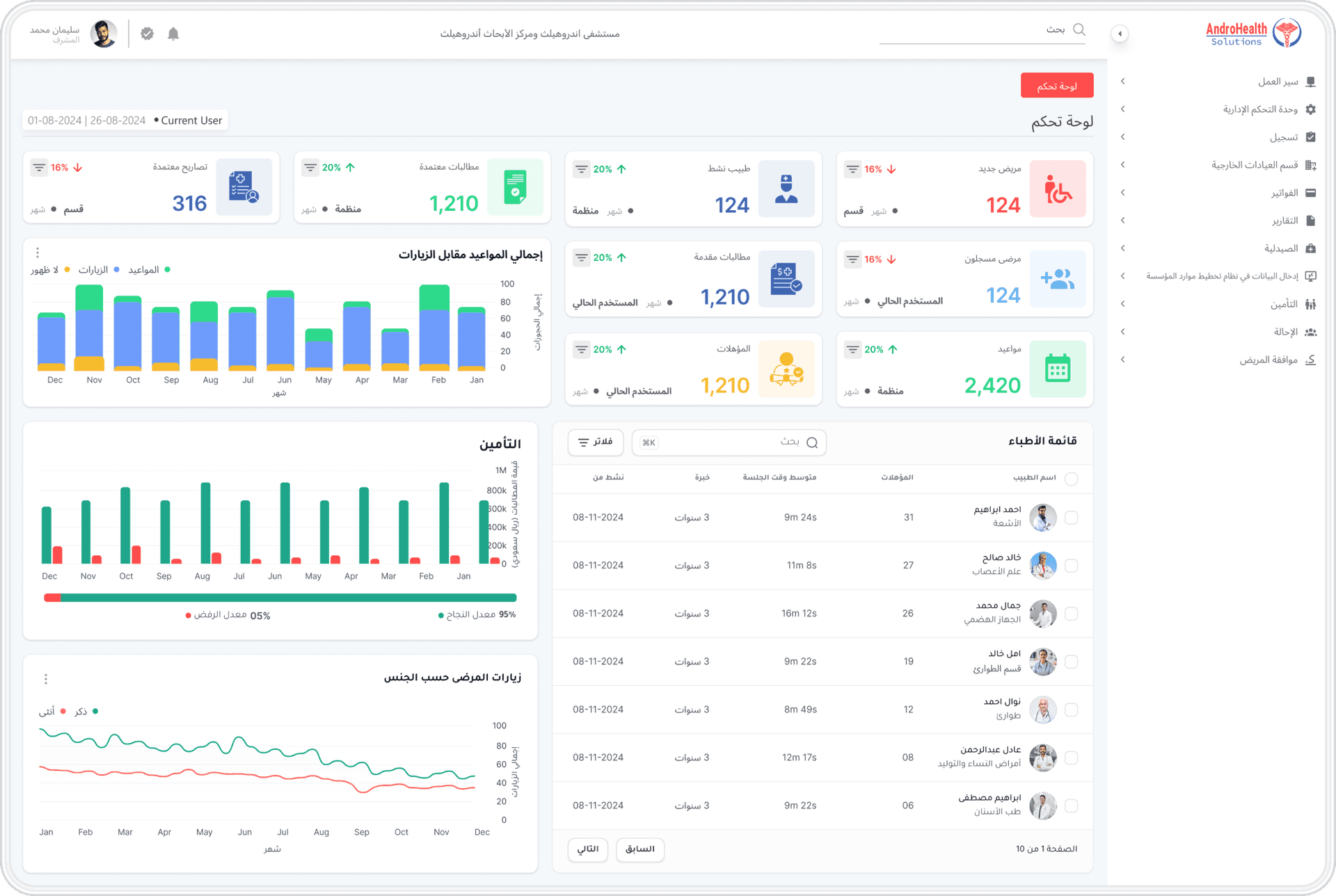
Choosing wisely now saves years of friction later. If you are evaluating options, AndroHealth was built for the Saudi context, with NPHIES and ZATCA integration, full Arabic support, strong data protection, and specialized editions for clinics of every kind, making it a natural fit to assess against this checklist.